



Parimutuel betting is different from regular betting because you bet against other people instead of betting against a bookmaker or casino. All the money wagered goes into a shared pool, and after the betting company takes its cut, the remaining money gets split among everyone who picked the winning outcome. This means your payout depends on how many other people made the same bet as you.

In parimutuel betting, the odds are not set in advance and only get calculated after all bets are placed and the event is over. If you bet on a popular choice that many others also picked, your payout will be smaller because you share the pool with more people. If you bet on an outcome that fewer people chose, your payout will be larger.
This betting system is most common in horse racing, greyhound racing, and similar events where competitors finish in a ranked order. You’ll learn how the pool system works, what types of bets you can make, and how to develop a strategy that works for this unique betting style.
What Is Parimutuel Betting?
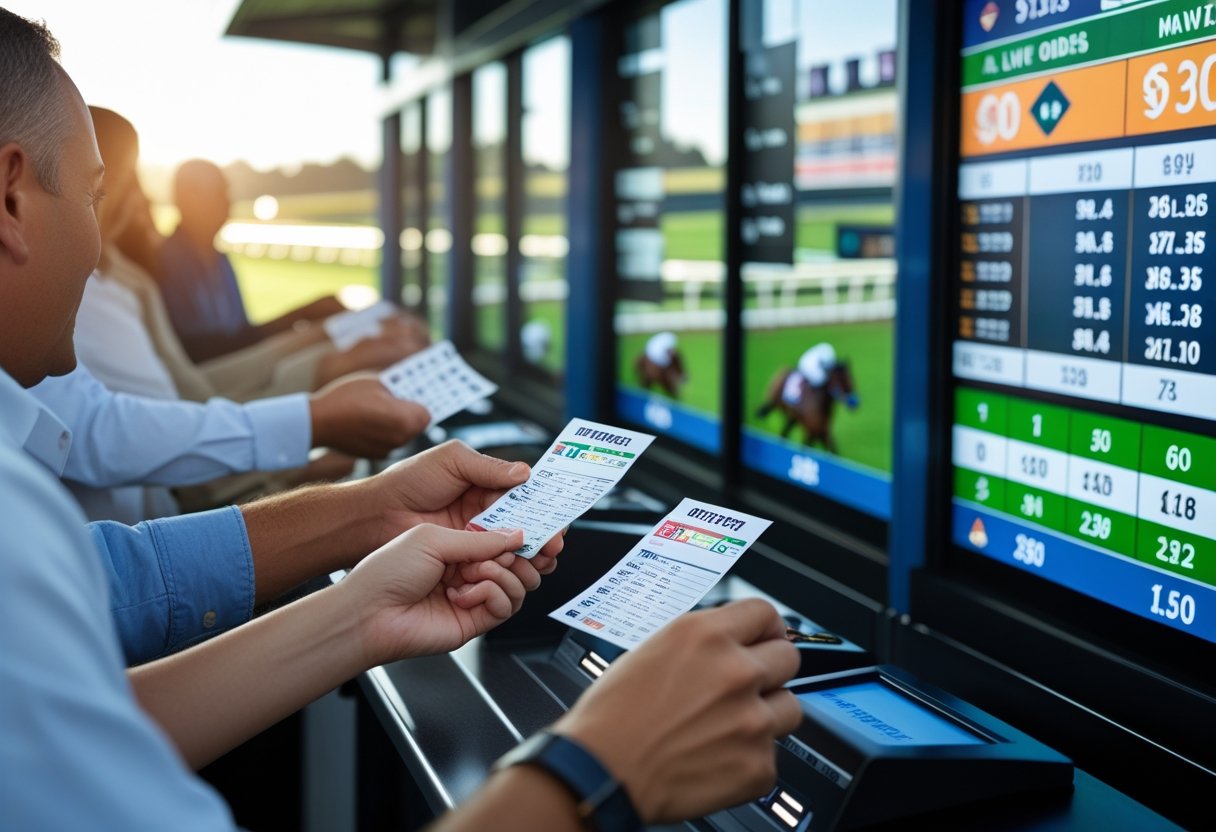
Parimutuel betting is a pool-based wagering system where all bets are collected together and payouts are determined by sharing the total pool among winners after deductions. Unlike traditional bookmaker betting, you bet against other bettors rather than against the house, and your winnings depend on how much money was wagered on each outcome.
Definition and Core Principles
Parimutuel betting, also called pari-mutuel betting or pool betting, places all wagers of the same type into a collective pool. When you place a bet, your money combines with everyone else’s money betting on that event. The betting facility then deducts a commission, typically between 14-18%, which covers taxes and operational costs.
After the event concludes, the remaining pool gets divided among all winning tickets. Your payout depends on two factors: the total amount in the pool and how many people bet on the winning outcome. If fewer people picked the winner, each winning ticket receives a larger share of the pool.
The odds aren’t fixed when you place your bet. They fluctuate based on betting activity until wagering closes. You won’t know your exact payout until all bets are finalized, which makes parimutuel betting fundamentally different from other betting systems.
Origins and History
Joseph Oller, a French-Catalan entrepreneur, invented the parimutuel system in 1867. He created this mutual betting approach to offer a fairer alternative to bookmakers who controlled odds and profits.
The system’s complexity led to the development of the totalisator, or “tote board,” by Australian engineer George Alfred Julius. The first totalisator was installed at Ellerslie Racecourse in Auckland, New Zealand in 1913. This mechanical calculating machine could process the large number of calculations needed to determine payouts quickly and accurately.
The United States adopted parimutuel betting in 1927. This introduction enabled the opening of major racetracks like Arlington Park near Chicago and Sportsman’s Park in Cicero, Illinois in 1932.
Comparison with Fixed-Odds Betting
In fixed-odds betting, you know your exact payout when you place your bet. The bookmaker sets the odds, and they remain locked in regardless of how other people bet. If you bet $10 at 5-to-1 odds, you’ll win $50 plus your original stake if you win.
Parimutuel betting works differently. Your payout isn’t determined until the betting pool closes. If many people bet on the same outcome you chose, your winnings decrease because the pool gets divided among more people. If you picked an unpopular choice that wins, your payout increases.
You also can’t break the bank in parimutuel betting because you’re betting against other gamblers, not the house. The betting facility simply manages the pool and takes its commission. This structure makes parimutuel betting legal in many places where other forms of gambling are restricted.
How Parimutuel Betting Works

In parimutuel betting, all wagers go into shared pools where the house deducts a percentage before dividing the remaining money among winners based on their share of the betting pool. Your final payout depends on how much money other bettors placed on each outcome, not on fixed odds set when you make your bet.
Formation of Betting Pools
When you place a parimutuel bet, your money goes into a betting pool with all other wagers of the same type. Each bet type creates its own separate parimutuel pool. A win bet has one pool, while place bets have another.
The total pool grows as more bettors add their wagers. If you bet $10 on horse number 4 to win and other bettors collectively put $100 more on that same horse, the total amount wagered on horse 4 is $110. Meanwhile, other horses have their own amounts wagered.
All betting action stops once the race or event starts. The parimutuel pool closes and no new bets can be added. At this point, the total pool amount is final and ready for payout calculations.
Dynamic Odds and Payout Odds
Your payout odds in parimutuel betting change constantly as more people bet. Unlike fixed-odds betting where your odds lock in when you place your wager, parimutuel odds shift with the betting action until the pool closes.
Before the event starts, you can see approximate odds based on the current pool. These dynamic odds tell you what your payout would be if no additional bets were placed. More money on a particular outcome lowers its odds, while less popular choices show higher potential returns.
The final payout odds only get calculated after the event concludes. If your selection wins, the remaining pool gets divided by the total amount bet on your outcome. For example, if $881.51 remains in the pool and $110 was bet on your winning choice, you receive $8.01 for every $1 wagered.
Role of the House Take and Breakage
Before winners receive any money, the track or betting operator removes the house take (also called takeout rate or rake) from the total pool. This percentage typically ranges from 14% to 20% depending on the venue and bet type. The house take covers operating costs and generates profit for the operator.
Track takeout gets deducted first from the parimutuel pools. If the total pool is $1,028 and the takeout rate is 14.25%, the operator removes $146.49. This leaves $881.51 to split among winning bettors.
Breakage represents another small deduction from your winnings. Most tracks round down payouts to the nearest 10-cent interval. If your calculated payout is $8.47 per dollar, the track rounds it down to $8.40 and keeps the difference. This breakage stays with the house as additional commission beyond the standard rake.
Key Components and Technology
Parimutuel betting relies on specialized technology to manage the pools of money and calculate payouts in real time. The totalisator system tracks all wagers and determines odds based on betting activity, while different types of bets allow you to choose various ways to participate in the pool.
The Totalisator and Tote Board
The totalisator, often called the tote, is the computerized system that handles all parimutuel betting operations. This technology collects every bet placed on an event and calculates the odds continuously as more money enters the pool. The system deducts the house take and determines how winnings will be distributed among those who picked correctly.
The tote board displays this information to bettors in real time. You can see the current odds for each competitor, the total amount of money in each pool, and how the odds shift as betting continues. Modern tote boards appear as digital screens at racetracks or as online interfaces on betting platforms.
This technology ensures accuracy and transparency in tote betting. The totalisator processes thousands of bets per minute and adjusts calculations instantly, making it possible for parimutuel betting to function smoothly across large betting pools.
Types of Parimutuel Wagers and Pool Bets
Parimutuel bet types fall into two main categories: straight bets and exotic bets. Straight bets are simpler pool bets where you pick one outcome. A win bet means you select which competitor will finish first. A place bet pays out if your choice finishes first or second. A show bet covers first, second, or third place finishes.
Exotic bets require you to predict multiple outcomes correctly and typically offer larger payouts. An exacta means picking the first two finishers in exact order. A trifecta extends this to the top three finishers. A superfecta covers the first four positions in order.
Other bet types include the quinella (first two finishers in any order) and the daily double (winners of two consecutive races). Each bet type creates its own separate pool, and your potential winnings depend on how much money goes into that specific pool and how many other bettors share your winning combination.
Popular Parimutuel Bet Types
Parimutuel betting offers several wager types that range from simple single-race predictions to complex multi-race combinations. The most basic bets focus on a horse’s finishing position, while exotic bets require you to predict multiple horses or outcomes across one or more races.
Win, Place, and Show Bets
Win bets are the simplest parimutuel wagers you can make. You select one horse, and if it finishes first, you collect your payout. The odds fluctuate based on how much money other bettors place on each horse in the pool.
Place bets pay out when your horse finishes either first or second. Your returns are lower than win bets because you have two chances to win instead of one.
Show bets offer the safest option among straight wagers. Your horse needs to finish in the top three positions for you to collect. These bets provide the lowest payouts because you have three ways to win.
An across the board bet combines all three types into one wager. You place equal amounts on win, place, and show for the same horse. If your horse wins, you collect on all three bets. If it places second, you get paid on the place and show bets only.
Exacta, Trifecta, Superfecta, and Other Exotics
Exacta bets require you to pick the first two finishers in exact order. A quinella is similar but allows either order for your two selections, offering lower payouts with better odds of winning.
Trifecta wagers demand you predict the top three horses in exact finishing order. These bets offer substantially higher payouts than exactas due to increased difficulty.
Superfecta bets push the challenge further by requiring the top four finishers in exact order. The payouts can reach thousands of dollars even on small wagers because the odds of correctly predicting four positions are extremely low.
Multi-race exotics include the daily double (winners of two consecutive races), pick 3 or pick three (three consecutive race winners), pick 4 (four consecutive winners), and pick 6 (six consecutive winners). These function like a parlay where you must win every leg to collect, but the potential payouts increase dramatically with each additional race.
Parimutuel Betting in Practice
Parimutuel betting operates differently across various sports and locations, with horse racing remaining the primary application while legal frameworks shape how these betting pools function in different regions.
Horse Racing and Other Sports
Horse racing serves as the foundation for parimutuel wagering systems. When you visit a racebook, all wagers go into a shared pool rather than being placed against a bookmaker. The track or facility takes a percentage (typically 15-20%) before distributing the remaining funds to winning bettors.
Common parimutuel bet types include:
- Win, Place, Show – Basic bets on finishing positions
- Exacta – Picking first and second place in order
- Trifecta – Selecting the top three finishers in order
- Superfecta – Predicting the first four horses correctly
Greyhound racing also uses pari-mutuel wagering extensively. Some states have introduced this system for sports betting, where bettors compete against each other instead of against fixed odds. The betting pools adjust in real-time as more wagers come in, which means odds shift constantly until betting closes.
Legal and Regulatory Considerations
Parimutuel wagering faces different regulations depending on location. Most U.S. states allow pari-mutuel betting on horse racing, even in places where other gambling forms are restricted. This happens because lawmakers view it as a skill-based activity where bettors compete against each other.
Regulatory bodies require operators to maintain transparency about pool sizes and house percentages. They conduct regular audits to verify proper payout calculations. Some jurisdictions mandate minimum payout ratios to protect bettors.
Online parimutuel wagering has expanded access to betting pools. You can now participate in races across state lines through licensed platforms. However, you must verify that online pari-mutuel betting is legal in your specific state before placing wagers.
Strategy and Tips for Parimutuel Betting
Success in parimutuel betting requires a solid understanding of handicapping methods, careful bankroll management, and strategies that account for how the betting pool works. Unlike fixed-odds betting, your potential returns depend on how others bet, making it essential to analyze both the competition and the crowd’s behavior.
Handicapping and Use of Past Performances
Handicapping forms the foundation of any effective parimutuel betting strategy. You need to study past performances to identify patterns and evaluate each competitor’s strengths and weaknesses. For horse racing, examine factors like recent race times, track conditions, jockey statistics, and how the horse performed at similar distances.
Past performances provide concrete data points that help you make informed decisions. Look at the morning line odds as a starting point, but understand these are just estimates. The probable odds will shift as money flows into the pool, so you need to compare your own analysis against what the crowd thinks.
Focus on value rather than favorites. A horse with 5-1 odds that you believe should be 3-1 represents better value than a favorite at even money. Track the implied probability of each outcome and compare it to your own assessment to find discrepancies where you can gain an edge.
Managing Risk and Takeout Rates
Takeout rates directly impact your potential profits in parimutuel betting. The house removes a percentage from the pool before calculating payouts, typically ranging from 15% to 25% depending on the bet type and venue. This means you need to win more than you lose by a significant margin to be profitable.
Smart bankroll management protects you from the volatility inherent in parimutuel payouts. Set aside a specific amount for betting and never wager more than 2-5% of your total bankroll on a single race or event. This approach helps you survive losing streaks while staying in action long enough for your edge to materialize.
Consider the relationship between takeout rates and bet types. Exotic bets like trifectas often have higher takeout rates but can offer larger payouts. Simple win bets usually have lower takeout rates, making them better for conservative strategies focused on steady returns.
Distinctive Parimutuel Betting Strategies
Value betting works particularly well in parimutuel pools because you can find horses or competitors that the public underestimates. Wait until late in the betting period to see how the pool develops, then place bets on outcomes where the crowd has created inflated odds on quality selections.
Dutching allows you to spread risk across multiple outcomes in the same race. You calculate bet amounts on several competitors so that any win produces roughly the same profit. This strategy works when you identify multiple strong contenders but cannot pick a clear winner.
Key Strategic Approaches:
- Monitor pool changes – Watch how odds shift as betting progresses to identify where smart money is going
- Avoid low-value favorites – Public favorites often offer poor returns relative to their actual winning probability
- Focus on specific bet types – Master one or two wager types before expanding to exotic bets
- Track your results – Keep detailed records to identify which strategies work best for your betting style
The parimutuel payout structure rewards those who think differently from the crowd. When you correctly identify an outcome that others overlook, you benefit from the larger share of the pool allocated to that result.
Frequently Asked Questions
Parimutuel betting involves pool-based wagering where all bets are combined and payouts depend on the total amount wagered and the number of winners. Understanding how calculations work, what strategies exist, and how this system differs from other betting types helps you make informed decisions.
How are payouts calculated in parimutuel betting systems?
The payout calculation starts with the total pool of money wagered on an event. Before any winnings are distributed, the house deducts a commission, typically ranging from 14% to 18%.
The remaining amount is divided among all winning bets. Your payout depends on how much was bet on your winning outcome compared to the total pool.
For example, if $1,028 is wagered total and the house takes 14.25%, that leaves $881.51 to distribute. If you bet on an outcome that had $110 wagered on it, each dollar you bet would return about $8 (including your original wager). This means you profit $7 for every $1 bet.
The odds are not fixed when you place your bet. They change as more money comes into the pool until betting closes.
What strategies can be employed to increase winnings in parimutuel betting?
Handicapping is the primary strategy used in parimutuel betting. This involves analyzing factors like past performance, track conditions, and other variables to predict outcomes.
You can make “across the board” bets where you wager on the same horse to win, place, and show. This reduces risk because you can still receive a payout if your horse finishes second or third.
Box bets let you cover multiple outcome combinations in exotic wagers. A trifecta box with three horses covers all six possible finishing orders for those horses, though it costs six times the base bet amount.
Wheel bets pick one horse for a specific position and combine it with all other horses in the field. A “3-all” wheel means horse #3 must win, but any other horse can finish second.
Timing matters since odds fluctuate as money enters the pool. Watching betting patterns can help you identify value opportunities before the pool closes.
Can you explain an example of parimutuel betting in horse racing?
A win bet is the simplest parimutuel wager. You pick the horse that must finish first to collect your payout.
Place and show bets offer more flexibility. A place bet wins if your horse finishes first or second, while a show bet pays out for first, second, or third place finishes.
Exotic bets combine multiple horses in specific orders. An exacta requires you to pick the first two finishers in exact order. A trifecta extends this to the first three horses, and a superfecta covers the first four.
A daily double combines two consecutive races where you must pick the winner of both. Pick six bets require you to select winners in six consecutive races and often include progressive jackpots that grow until someone wins.
Quinella bets let you pick two horses to finish first and second in any order. This differs from an exacta box because it’s a single bet rather than two separate wagers.
What are the legal considerations for participating in parimutuel betting?
Parimutuel betting is legal in many jurisdictions where other forms of gambling are prohibited. This is because you bet against other participants rather than against the house.
State regulations frequently govern parimutuel wagering. Each location has specific rules about minimum payouts, commission rates, and acceptable bet types.
Some states require minimum payouts even when favorites win by large margins. For instance, regulations might mandate at least $1.10 returned on a $1 bet, even if calculations suggest a lower amount.
Off-track betting facilities allow you to place parimutuel wagers without being physically present at the event. These locations must be licensed and follow the same regulations as the main venue.
Online parimutuel betting availability varies by jurisdiction. You should verify that any platform you use operates legally in your location before placing bets.
How does parimutuel betting differ from fixed-odds betting?
Fixed-odds betting locks in your payout amount when you place your bet. You know exactly what you’ll receive if you win.
Parimutuel betting doesn’t determine your final payout until the betting pool closes. Your winnings depend on how many other people bet and what they wagered on.
In fixed-odds systems, you bet against the bookmaker. In parimutuel systems, you bet against other participants in the pool.
The house take differs between systems. Bookmakers build their profit margin into the odds they offer. Parimutuel systems deduct a transparent commission from the pool.
Independent bookmakers often offer better payouts than parimutuel pools because they operate with lower commission rates. However, parimutuel betting eliminates the risk of the bookmaker refusing to pay or going bankrupt.
What role does parimutuel betting play in lotteries?
Some lottery games use modified parimutuel systems for prize distribution. This means prize amounts aren’t fixed and depend on ticket sales and the number of winners.
When multiple people win the same lottery tier, the prize pool for that level gets divided equally among all winners. This differs from lotteries with guaranteed fixed prizes.
Parimutuel lottery structures affect jackpot sizes. Higher ticket sales create larger pools, which increases potential payouts for winners in each tier.
This system benefits lottery operators by eliminating the risk of paying out more than they collect. The total paid in prizes always equals a predetermined percentage of total sales minus operating costs.
You won’t know your exact winnings until after the drawing when officials calculate how many tickets won at each level. This creates uncertainty similar to traditional parimutuel betting on sporting events.