


Playing cards by hand gets tiring during long game nights, and uneven shuffles can make games feel unfair. Professional card shufflers solve both problems by mixing cards quickly and randomly. These machines range from basic battery-powered models to casino-grade equipment that can handle multiple decks at once.
Professional card shufflers are automatic devices designed to shuffle one or more decks of cards efficiently and fairly, with models available from around $30 for home use up to several hundred dollars for casino-quality equipment. You can find shufflers that work with standard poker cards, bridge-sized decks, and even specialty game cards. Some models just shuffle while others both shuffle and deal cards to multiple players.
Understanding what separates a professional shuffler from a basic one helps you pick the right model for your needs. Casino-quality shufflers use patented technology and durable construction, while home models focus on convenience and lower prices. The right shuffler depends on how often you play, how many decks you need to shuffle, and whether you want extra features like automatic dealing.
What Is a Professional Card Shuffler?
A professional card shuffler is a device designed to mix playing cards thoroughly and efficiently for casino use, tournaments, and serious home games. These machines eliminate human error in shuffling and ensure fair, random card distribution every time.
Definition and Purpose
A professional card shuffler is a specialized machine that randomizes playing cards using mechanical or electronic systems. These devices are built to handle the demands of casinos, poker rooms, and gaming venues where consistency and fairness are essential.
The primary purpose is to create truly random card distribution. Manual shuffling by dealers can introduce patterns or biases, whether intentional or not. Professional shufflers remove this variable completely.
These machines also speed up gameplay significantly. A professional card shuffler can mix one or more decks in seconds, reducing downtime between hands. This efficiency is valuable in casinos where time directly impacts revenue.
Professional models differ from consumer versions in durability and performance. They’re engineered to shuffle thousands of times daily without breaking down or requiring frequent maintenance.
How Professional Card Shufflers Work
Most professional card shufflers use rotating drums or rollers to mix cards. When you insert a deck, the machine separates cards into different compartments using mechanical arms or pneumatic pressure.
Electric shufflers employ motors and gears to move cards through the mixing process. Cards pass through multiple stages where they’re randomly redistributed. Some models use sensors to detect card position and ensure proper alignment.
Higher-end systems use pneumatic shuffling that relies on air pressure. Air jets and suction separate and redistribute cards with precision. This method is common in casinos because it handles multiple decks quickly.
The shuffling cycle typically takes 3-10 seconds depending on the model and number of decks. Cards emerge fully randomized and ready for dealing. Many professional units can handle 1-6 decks simultaneously.
Types of Card Shufflers
Manual shufflers require physical operation through cranks or levers. You insert cards and turn a handle to activate the mixing mechanism. These are affordable but slower than electric options.
Electric shufflers run on batteries or AC power and shuffle at the push of a button. They’re faster than manual versions and popular for home games and smaller poker rooms.
Automatic shufflers represent the most advanced technology. They shuffle and sometimes deal cards without any human intervention. Casino-grade models like those using US Patent #5,718,427 technology are built for continuous professional use.
Continuous shufflers are specialized automatic units that shuffle cards constantly during gameplay. Dealers can pull cards as needed while the machine keeps shuffling the remaining deck.
Manual vs Automatic Shufflers
Manual card shufflers cost less, typically ranging from $15-$50. They’re portable and don’t need electricity. However, they require physical effort and take longer to shuffle cards.
Automatic card shufflers offer superior speed and consistency. Professional models can shuffle multiple decks in seconds without user input. They cost more, usually $100-$500 for quality units, but save significant time during extended play sessions.
The choice depends on your needs. Casual players might prefer manual shufflers for occasional use. Serious poker players and dealers benefit from automatic models that maintain game flow and eliminate shuffling fatigue.
Automatic shufflers also provide better randomization. They use programmed algorithms and mechanical precision that manual devices can’t match. This makes them the standard choice for tournaments and casino environments where fair play is paramount.
Key Features of Professional Card Shufflers
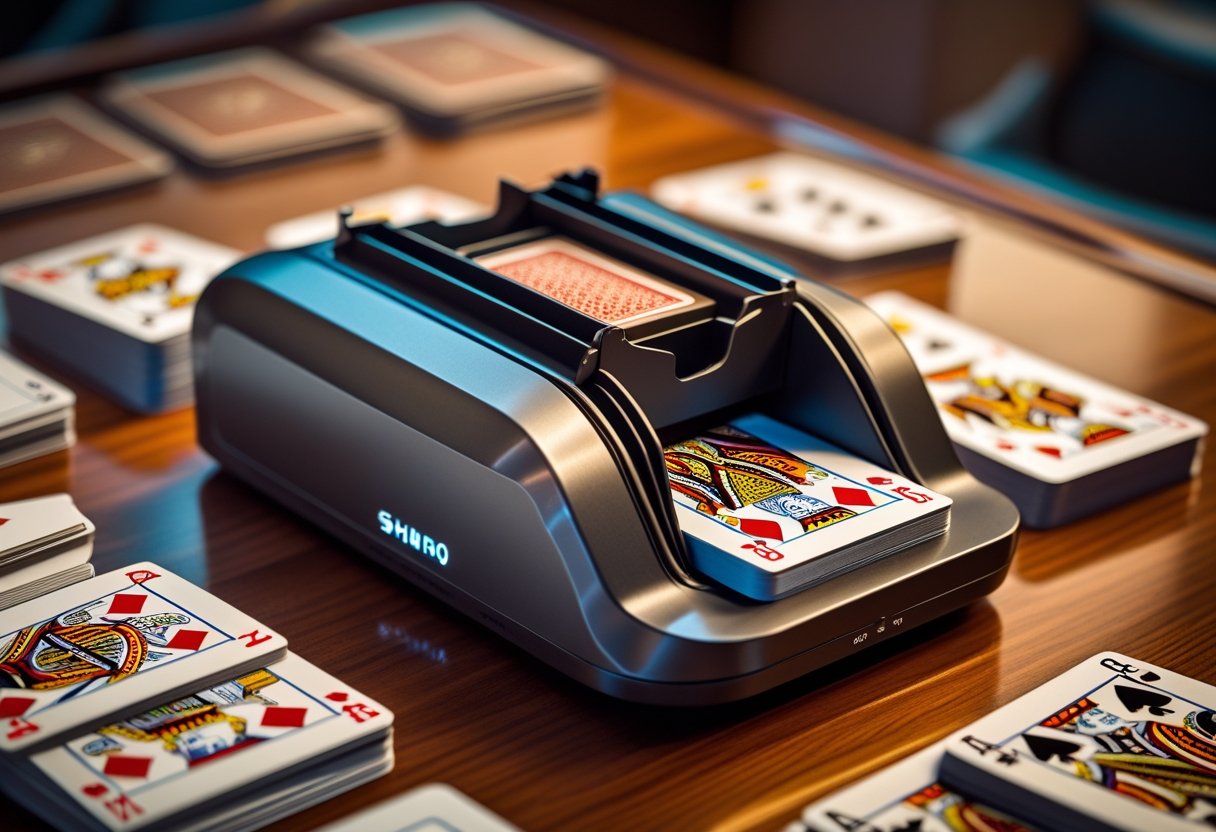
Professional card shufflers include several important features that affect how well they work during games. The capacity to handle multiple decks, power options, operating noise, and construction quality all play a role in choosing the right shuffler for your needs.
Shuffling Capacity and Deck Handling
Most professional card shufflers handle between one and six decks at a time. Single-deck models work well for games like blackjack at smaller tables. Multi-deck shufflers handle two to six decks and fit better in busy casino environments where games move quickly.
The MDS-6 multi-deck shuffler represents the higher end of capacity options. It processes up to six decks in a single batch. Continuous shufflers work differently by mixing cards constantly throughout play rather than in batches.
Your choice depends on the games you run. Poker rooms typically need one or two-deck capacity. Casino table games like baccarat often require four to eight-deck handling. A fully automatic shuffler saves time by requiring just one button press to complete the entire shuffling cycle.
Power Supply Options
Professional shufflers use two main power sources. AC-powered models plug into wall outlets and provide steady operation without battery concerns. These work best for permanent casino installations where outlets are easily accessible.
Battery-powered shufflers offer portability for home games or tournament travel. Many rechargeable models include USB-C charging ports and 2000 mAh batteries that last several hours. Some high-end units include both AC adapters and battery options for flexibility.
Electric card shufflers need reliable power to maintain consistent shuffling speed. Check the power requirements before buying to make sure your setup can support the unit’s needs.
Noise Level and Discreet Operation
Noise level matters in professional gaming environments. Loud shufflers distract players and disrupt table conversation. Quality models operate at low volumes that blend into normal room noise.
Modern professional shufflers use quiet motors and sound-dampening materials. The best units produce minimal mechanical noise during operation. This discreet operation helps maintain the atmosphere at gaming tables.
Look for models specifically marketed as “low noise” or “ultra quiet.” These typically measure under 60 decibels during operation, similar to normal conversation volume.
Durability and Build Quality
Professional shufflers must withstand heavy daily use in casino settings. Commercial-grade units feature metal components and reinforced housings that resist wear. Consumer models often use more plastic parts that may not hold up under constant use.
Build quality affects shuffle consistency over time. Well-constructed shufflers maintain their randomization effectiveness even after thousands of cycles. Cheaper units may develop mechanical issues that affect shuffle quality.
Professional models often include security weights to prevent movement during operation. They also feature card detection sensors that stop the shuffle when complete. These details separate professional equipment from basic consumer shufflers.
Compatibility and Card Handling
Professional card shufflers work with different card types and sizes, though specific compatibility varies by model. Most devices handle standard poker cards and popular game cards, while plastic and paper materials each present unique handling characteristics.
Supported Card Types and Sizes
Most professional card shufflers accommodate standard poker-sized cards, which measure 2.5 by 3.5 inches. Many models also work with bridge cards, which are slightly narrower at 2.25 by 3.5 inches. The adjustable card stoppers in higher-end models let you use cards from games like UNO, Rummy, and Texas Hold’em without modifications.
Your shuffler’s capacity typically ranges from one to two decks for basic models. Some advanced units handle up to four decks at once. The card thickness matters too. Standard cards measure around 0.01 inches thick, and most shufflers work best when you stay within this range.
Check your shuffler’s specifications before buying specialty cards. Oversized or undersized cards may jam the mechanism or shuffle poorly.
Plastic vs Paper Cards
Plastic cards glide through shuffler mechanisms more smoothly than paper cards. They resist bending and maintain consistent thickness, which reduces jamming. Paper cards absorb moisture and can stick together, especially in humid conditions.
Your shuffler may need different settings for each material. Paper cards require gentler handling to prevent wear on the corners and edges. Plastic cards tolerate higher shuffling speeds without damage.
Most professional models work with both materials. However, plastic cards extend your shuffler’s lifespan by creating less friction against internal components.
Card Compatibility for Games
Your card shuffler works with multiple game types if you match the card dimensions correctly. Poker, Blackjack, and Texas Hold’em all use standard-sized cards that fit most shufflers. Games like Skip-Bo, Phase 10, and Crazy Eights also work in compatible devices.
UNO cards present a unique case. They’re slightly smaller than poker cards but fit in shufflers with adjustable trays. Bridge and Canasta use their own card sizes, so verify compatibility before shuffling.
Some shufflers include game-specific presets that adjust dealing patterns for different player counts. These settings work for games supporting one to twelve players.
Presentation Tray and Accessories
The presentation tray catches shuffled cards and keeps them organized between rounds. Open-sided trays make card removal easier and work with various card sizes. Some models include a translucent lid that protects cards from spills while letting you see the shuffling process.
Quality trays feature smooth surfaces that prevent card scratching. They should hold your full deck without cards spilling over the edges. Removable trays simplify cleaning when dust or debris accumulates.
Additional accessories include wireless remotes for dealer functions and USB-C charging cables. Some units come with multiple remotes so each player can call for cards during the game.
Technologies and Patented Mechanisms
Professional card shufflers use specific techniques that have been refined over decades, with some methods protected by patents in casino equipment. The core shuffling methods—riffling, hand cutting, and stripping—each serve distinct purposes in randomizing cards, while even shuffles ensure game integrity.
Patented Shuffling Process
Automatic card shufflers use patented mechanisms to randomize playing cards efficiently. These machines typically separate individual cards from an unshuffled deck and distribute them randomly into multiple compartments using motorized rollers and computer-controlled systems.
Casino-grade shufflers employ carousel or elevator configurations to hold cards temporarily. A carousel design rotates storage compartments radially to accept cards at random positions. An elevator design moves compartments up and down in a linear stack.
Most patented systems require pusher mechanisms to move cards between stations. These motorized components physically transfer cards from input areas into storage compartments and then push completed card groups to output stations. Early designs used as few as four compartments, while modern commercial shufflers typically use eight to nine compartments for proper randomization of a standard 52-card deck.
Riffling, Hand Cutting, and Stripping
Riffling involves splitting the deck into two roughly equal portions and interlacing the cards by releasing them from your thumbs. You bend each half slightly and let the cards fall together in alternating sequence. This technique produces the strongest randomization effect when performed correctly.
Hand cutting means dividing the deck into sections and restacking them in different order. You lift a portion from the top or middle and place it elsewhere in the deck.
Stripping requires you to pull small groups of cards from the top of the deck and drop them into your other hand. You repeat this action multiple times, effectively reversing and mixing small packets throughout the deck.
Even Shuffles and Game Security
Even shuffles maintain specific card distributions that professional shufflers must avoid. An eight-shuffle riffle with perfect alternation returns a deck to its original order, compromising game security.
Casino operations require shufflers to introduce true randomness through security weights—additional shuffle rounds beyond minimum requirements. You need at least seven riffle shuffles to adequately randomize a standard deck according to mathematical research.
Professional shufflers combine multiple techniques in varied sequences. You might perform three riffles, one strip, two cuts, and another riffle to prevent pattern recognition. This approach ensures that card order remains unpredictable across games.
Top Professional Card Shuffler Models
Professional-grade card shufflers deliver consistent performance for serious card rooms and gaming operations. The Shuffle Tech ST-1000 and ProShuffle MDS-6 represent industry standards, while several other brands offer reliable alternatives for different needs and budgets.
Shuffle Tech ST-1000
The Shuffle Tech ST-1000 stands as one of the most trusted shufflers in professional card rooms. This machine handles single decks with precision and speed that manual shuffling cannot match.
The ST-1000 uses a random mixing algorithm that ensures true randomization with each shuffle cycle. You can expect consistent performance across thousands of shuffle cycles without degradation in quality. The machine completes a full shuffle in approximately 20 seconds.
Key specifications:
- Capacity: Single deck
- Shuffle time: ~20 seconds
- Power: AC adapter
- Build: Commercial-grade components
Casinos and poker rooms choose the ST-1000 for its reliability during extended use. The shuffle tech design minimizes card wear compared to hand shuffling. You will find this model in both tournament settings and cash game operations where shuffle integrity matters most.
ProShuffle MDS-6
The ProShuffle MDS-6 multi-deck shuffler handles up to six decks simultaneously. This capacity makes it ideal for games like blackjack where multiple decks are standard.
The MDS-6 features automatic card feeding and collection. You simply load the decks and start the cycle. The machine sorts and randomizes all cards before dispensing them ready for play.
This shuffler processes six decks in under 60 seconds. The construction uses heavy-duty materials designed for continuous daily operation. Casino environments demand this level of durability, and the MDS-6 delivers consistent performance shift after shift.
Other Leading Brands
Several manufacturers produce quality shufflers for professional environments. ShuffleBox offers the G1 Pro model with both shuffling and dealing capabilities in one unit. This 2-in-1 design saves table space while providing automated card distribution.
KPAW manufactures shufflers with remote card calling features. These units support up to 12 players and include preset game modes for different card games. The rechargeable design allows for portable use across multiple tables.
INNCNN produces combination shuffler-dealer machines with programmable settings. You can customize dealing patterns and player counts based on your specific game requirements. These models work well for facilities running multiple game types throughout the day.
Practical Considerations for Buyers
Professional card shufflers require careful evaluation beyond basic features. Budget constraints, manufacturer support, power specifications, and operational efficiency directly impact your long-term satisfaction and total cost of ownership.
Price and Cost Factors
Professional card shufflers range from $100 to over $500 depending on build quality and features. Entry-level automatic models start around $50 to $100, while casino-grade shufflers designed for continuous tournament use typically cost $200 to $400. High-end models with dealing functions and advanced sensors can exceed $500.
Your cost calculation should include replacement parts and maintenance expenses. Professional models with anti-jamming systems and reinforced components reduce repair frequency but command higher upfront prices. Battery-operated units add ongoing costs for replacements, while plug-in models eliminate this expense. The price difference often reflects durability rather than shuffling quality alone.
Consider cost per use if you host frequent games. A $300 shuffler used weekly for years delivers better value than a $50 model requiring replacement every six months.
Warranty and After-Sales Support
Manufacturer warranties for professional shufflers typically range from 90 days to two years. Casino-grade models often include one-year warranties with optional extensions. Limited warranties usually cover manufacturing defects but exclude damage from misuse or normal wear.
Review what your warranty actually covers. Some manufacturers only replace defective units while others offer repair services. After-sales support matters significantly for professional-grade equipment. Check if the manufacturer provides phone or email technical support, replacement parts availability, and repair service locations.
Companies with established reputations in gaming equipment generally offer more reliable support channels. Read customer reviews specifically about warranty claims and response times before purchasing.
Continuous Gameplay and Stand-By Mode
Professional shufflers built for extended sessions include thermal protection to prevent motor burnout during continuous use. Models designed for casinos can shuffle continuously for 8 to 12 hours without overheating. Entry-level electric shufflers may require cooling breaks after 30 to 60 minutes of repeated operation.
Stand-by mode features reduce power consumption between shuffles. This function keeps the device ready for immediate use while extending motor life. Some models automatically enter stand-by after 5 to 10 minutes of inactivity.
Check the manufacturer’s specifications for duty cycle ratings. Professional units specify maximum shuffles per hour, typically 60 to 100 cycles. Exceeding these limits voids most warranties and accelerates component wear.
Universal Adapter and Power Requirements
Professional shufflers operate on AC power, batteries, or both. Plug-in models require 110V or 220V depending on your region. Universal adapters that support 100-240V eliminate compatibility issues when traveling internationally or relocating equipment.
Battery-operated shufflers typically use 4 to 6 C or D batteries, lasting 20 to 40 hours of use. Hybrid models offer both battery and AC options for flexibility during power outages or outdoor events. USB-C rechargeable batteries provide a modern alternative in newer models, reducing long-term battery costs.
Verify the power cord length for plug-in models. Professional setups often need 6 to 10 feet of cord to reach outlets without extension cables. Some high-end shufflers include detachable power cords for easier storage and replacement.
Frequently Asked Questions
Professional card shufflers vary in features, capacity, and price, with top models offering casino-quality shuffling for multiple decks. Understanding shuffle speeds, deck capacity, and operational requirements helps you select the right shuffler for your needs.
What are the top-rated professional card shufflers on the market?
The Shuffle Tech ST-1000 stands out as a leading professional card shuffler. It costs $799.99 and offers casino-quality shuffling with transparent operation.
This model shuffles cards in 40 seconds using its quick-paced mode. It can also perform seven riffles for complete randomization in 80 seconds.
The FEIERYA Automatic Card Shuffler provides a budget-friendly option for home use. It runs on batteries and handles two decks at once. This shuffler works well for casual game nights and travel.
How do professional card shufflers compare to casino-grade shufflers?
Professional card shufflers like the Shuffle Tech ST-1000 use the same shuffling techniques found in casinos. They perform real hand cutting, riffling, and stripping to randomize cards thoroughly.
Casino-grade shufflers prioritize transparency and speed. The Shuffle Tech model features a clear lid so everyone can watch the shuffling process. It completes a casino dealer’s shuffle in 40 seconds.
Professional models also include stand-by modes for continuous gameplay. While you remove one deck, the shuffler prepares a second deck in under three seconds.
What is the price range for high-quality professional card shufflers?
High-quality professional card shufflers typically range from $100 to $800. Basic automatic models for home use start around $30 to $100.
Mid-range professional shufflers cost between $200 and $500. These models offer faster shuffling speeds and better build quality than entry-level options.
Premium professional shufflers like the Shuffle Tech ST-1000 cost around $800. These models provide casino-grade performance and durability. They include advanced features like multiple shuffle modes and quick deck swapping.
How does a card shuffler improve the dealing process for card games?
Card shufflers eliminate uneven shuffles that can occur with manual shuffling. They ensure each card has an equal chance of appearing in any position in the deck.
Professional shufflers speed up game play significantly. A model like the Shuffle Tech ST-1000 completes a full shuffle in 40 seconds, while manual shuffling takes much longer.
Automatic shufflers protect your cards from wear and damage. Manual shuffling bends and creases cards over time. Machine shuffling reduces this physical stress on your deck.
Can professional card shufflers handle multiple decks, and if so, how many?
Most professional card shufflers handle one to two decks at a time. The FEIERYA model shuffles up to two decks simultaneously for home games.
Some high-end models can shuffle up to eight decks. These larger capacity shufflers work best for games like blackjack that require multiple decks.
Single-deck shufflers with stand-by modes offer an alternative to multi-deck capacity. The Shuffle Tech ST-1000 shuffles one deck while you deal another, keeping games moving quickly.
What factors should be considered when purchasing a professional card shuffler for home use?
Shuffle speed matters for maintaining game flow. Look for models that complete shuffles in 40 to 90 seconds. Faster shuffling keeps players engaged and reduces downtime.
Deck capacity should match your typical games. Buy a two-deck shuffler if you play games like poker or rummy. Consider higher capacity models for blackjack or other multi-deck games.
Power source affects portability and convenience. Battery-powered models work well for travel and outdoor use. Electric models with AC adapters provide consistent power for home game rooms.
Card compatibility is critical for proper operation. Professional shufflers require 100% plastic cards. Paper cards can jam the mechanism and reduce performance.
Size and portability determine where you can use the shuffler. Compact models around 11 by 8 by 6 inches fit easily on most gaming tables. Lightweight designs under 10 pounds move between locations easily.
Noise level impacts the gaming experience. Quiet operation lets players focus on the game without distraction. Check product reviews for information about operational noise.